



Skip to content
Reading Horizons Logo

This article was originally published on the Learning Counsel website.


How teaching reading has (and hasn’t) changed over the past 30 years.

digital-literacy-instruction

Companies that have been in the game for a while have been courtside in watching EdTech explode over the past 35 years. Even as schools and districts rushed to buy the new, hottest thing, to me the question has always been whether a given piece of tech actually held enough substance to improve student learning.

When it comes to teaching literacy, a huge shift happened in 1999 when the National Reading Panel put out a report saying that if you don’t teach phonics as the foundation of a structured literacy approach, you’re severely crippling the ability of as many as 30 percent of your students who are striving to learn to read. The report found that a foundation in phonemic awareness and phonics was essential.

Not all educators have embraced phonics, and it’s true that the majority of students can learn to read regardless of how they’re taught. It’s also true that as many as 30 percent will struggle and they frequently go undiagnosed through 3rd grade if they are left to their own devices. Structured literacy instruction does not delay learning but expands the mind and capacity of every student, without the risk of failure for 30 percent.

It has been exciting to see the focus shift to getting educators trained in the methodologies behind the science of reading. Once educators have the know-how, they can give students the skills, the rules and the ability to decode and understand the structure of language. It all begins with phonemic awareness—knowing the sounds of letters and being able to blend sounds together to form words. When students unlock that code, it’s a whole new world. While the pendulum has swung when it comes to methodology, the tech has changed, too. Here are a few ways teaching literacy has transformed over the past 30 years.

From Floppy Discs to Web-Based Learning

Thirty years ago, parents were appalled at the thought of their kids learning how to read on a screen instead of in a book. On a smaller scale, that concept still has a lot of opposition.

Back in the day, the Accelerated Reader (AR) software owned the K–6 landscape. Students would read a book and then get on a computer to take a quiz revolving around the reading. Students who achieved a certain number of points could attend an AR party held by their school. The software proliferated across most of the country in the 1990s and early 2000s and was the primary focus for literacy learning using digital tools. But that was the extent of the use of screens when it pertained to learning how to read.

My company, Reading Horizons, has been in business long enough to experience the transition from floppy discs and audio tapes to CD technology and now to a web browser where we can enable the program instantaneously. It’s like going from a bicycle to a rocket ship. Online content and tools have made information and instruction available 24/7. Students can, in theory, move at a pace that is right for them. The investment in technology across our K–12 school systems has been significant. The adoption and adapting to that technology has not been nearly as prolific. Educators have struggled to integrate what has been purchased and to relinquish some of their role to a digital voice.

Quality Over Eye Candy Tech

Now that districts have an abundance of EdTech to choose from, the challenge they face is differentiating quality teaching and learning tools from purely “eye candy” tech. There’s a lot of good-looking tech out there that doesn’t have a lot of substance. Districts have spent millions on software over the last 20 years that hasn’t moved the needle. It’s not helping the 25 percent of students that need it the most because it doesn’t show them the “how” of reading. It’s a challenge educators face because the tech might look like it would appeal to the student, but it isn’t helping them learn in an effective way.

Phonics-based instructional software can help educators focus on the “how” in ways that can be tailored to the student. Multisensory reading instruction has been proven to be the most effective, even among students with dyslexia. Tech can teach students how to read and then expose them to controlled text, improving their fluency and comprehension.

Assisting, Not Replacing, the Educator

In terms of making educators’ lives easier, we’ve come a long way from the days of floppy discs, when a school would have to buy five licenses to get software on five computers. Now, students can access tech tools on multiple devices, anywhere in the world with an Internet connection. There’s no comparison.

EdTech is at its best when it’s augmenting and reinforcing an educator’s lesson. It extends an educator’s reach and allows students to learn and comprehend faster. No matter how tech changes, the educator’s role in delivering instruction and mentoring students will not go away. When students get to higher grades, an effective tech tool will allow educators to follow up with literacy students since they’re at so many different levels of reading that it’s hard for an educator to tend to them all as a class.

As we move into the age of artificial intelligence and machine learning, the assessment options are expanding exponentially. One only has to take a moment to review reports from 30 years ago to see how far we have come as it pertains to student analytics and progress monitoring. So much more can be ascertained through the use of pinpointed assessments and data-gathering. With all the improvements in hardware and software, teaching is still teaching, and tech’s role will always be to allow teachers to focus on the pedagogy that will help the broadest group of students.

What works well for children learning to read should work well for ELLs, as well. Helping them understand the structure of English empowers them and builds their confidence. Most have been told that English is full off exceptions and they will just have to memorize what words say, instead of learning the sounds and patterns. That is simply not true.

For today’s EdTech to be truly effective, educators need to understand and believe that software can augment their teaching and allow for students to be pre-taught and retaught as needed. As teachers adjust to the digital tools and better understand how to use them to extend their reach, we will see tremendous advantages, especially for students who are ready for more advanced content and for those who might struggle. Software tools must be up to the challenge.


Tyson Smith is the CEO of Reading Horizons, a phonics-based literacy program that recently celebrated 35 years of helping educators teach students how to read.


Originally published on eSchool News

It was my first day with my group of Tier III 2nd-graders, and they were ready to go around the room and introduce themselves. It was going fine until one student said something surprising.

“I’m Jacob, and I can’t read.”

It was odd. I learned later that Jacob was a competitive gymnast and a smart kid, but he chose to identify himself as someone who couldn’t read well. I told him that I specialize in reading and that I’d help him fix that.

Pinpointing the problem

It wasn’t long before I recognized that Jacob had the telltale characteristics of someone who has dyslexia. This 2nd-grader had an impressive vocabulary, but he was having trouble decoding the simplest words. It didn’t make sense. I talked to his mom about it, and she told me that Jacob’s uncle has dyslexia. Because dyslexia is hereditary, Jacob’s parents decided to go to the doctor for a formal assessment. The dyslexia diagnosis came back positive.

Jacob was using so much cognitive space trying to memorize the words on his spelling tests that he wasn’t able to understand the patterns of letter-sound relationships. Talking to him was like talking to a little professor, but he’d lose so much confidence after he’d fail each spelling test. The way I explain dyslexia to my students and their family members is that most children have a file folder in their brain that develops and grows wider as they’re learning how to read. For Jacob, the file wasn’t there. We needed to create the file.

Discovering a solution

A representative from Reading Horizons Discovery® came to our school to present an explicit, phonics-based approach to teaching reading. I knew that it was what I needed to help Jacob and students like him to succeed. I went to my principal that day and told him he needed to buy the program.

I meet with a group of students the district has classified as tier three for 45 minutes four times a week. They have different reasons for being in my class, but they are at the same general level in reading and need to develop the same skillset.

An eye-opening journey

When I introduced the program to my class the next year, I cautioned them. The program would start with topics like the ABCs—subject areas that were younger than my now 3rd-graders. I reassured them that we all have different holes to patch up and this program would help us figure out where they were. By starting out at the beginning, I was able to see which student’s learning gaps came earlier or later. My job was to be the road-patcher and make learning how to read a smooth journey.

It was eye-opening. Some students were having issues with the B and D reversal or misunderstanding vowel sounds. I promised that by the time we finish this program, we would be able to decode any word. Jacob’s goal is to decode “supercalifragilisticexpialidocious,” of course.

Students with dyslexia tend to think that they just aren’t one of the smart kids in their class, but that’s not the case at all. Once I told Jacob some of the research behind dyslexia, he saw it not as a disability but as what makes him special. He also discovered that he wasn’t alone. Many other people have honed in on their gifts despite having dyslexia. A huge portion of my job is to act as my students’ advocate. It increases their motivation to learn and grow. If Jacob had remained discouraged and dug himself into his holes, he wouldn’t be where he is today. Now, Jacob is in 5th grade, and though he hasn’t tested out of my class yet, he’s so much closer to decoding “supercalifragilisticexpialidocious.”

This article was originally published on eSchool News.


See how a district is implementing a personalized approach to reading backed by extensive, ongoing PD

elementary-reading-curriculum

Demographics:

Rockford Public Schools is one of the largest school districts in Illinois, with more than 28,800 students and 44 schools.

Biggest challenge:

There were many gaps in foundational reading across classrooms before we piloted our new reading program. It didn’t seem that we had a common methodology to teach foundational literacy. We were looking for a resource to fill this gap. We also were lacking in the area of personalized learning that supported foundational literacy skills. We were having trouble supporting students who needed extra help while providing enrichment for students who were already thriving.

Solution:

Every single student needs whole-group instruction that’s explicit, modeled, and demonstrated by teachers. Our literacy program supports best practice by encouraging teachers to implement the “I do, we do, you do,” approach to learning. After whole-group instruction, our teachers designate time for small-group learning. The expectation district-wide is for K–5 small-group lessons to happen every day. Teachers meet students where they are in their learning, using data to drive instruction. In Rockford, small-group instruction includes skill-based groups, guided reading, or literature circles.

With the combination of small groups and the time we give students to read and write independently, they are able to work towards mastery of foundational skills. Students also have additional time to flesh out skills using tech tools that support instruction. We’ve implemented Reading Horizons Discovery, a phonics-based literacy curriculum that tailors lessons to each student’s ability level. We use a blended approach to learning to support explicit instruction, small-group instruction, and the use of technology.

One thing Reading Horizons Discovery provides is the expectation for students to write, spell, and decode nonsense words. Unlike sight words that students might memorize, nonsense words provide the opportunity to demonstrate that they have mastered literacy skills.

Our district builds teacher capacity by supporting implementation. Before the beginning of each school year, our new teachers attend a two-day professional development training for the program. For ongoing support, we have monthly web training provided by implementation coaches, and also offer teachers two in-person coaching sessions a year.

Lessons learned:

  • Know your students, and believe they are capable of great things. Being reflective as educators and responsive to students is important for instructional strategies to be successful. One example of that success: We had a kindergarten classroom that saw 167-percent growth in reading scores from fall 2018 to this winter. The same classroom had some students score around 20 points higher than their projected growth scores.
  • Rather than just saying, “Oh, today you’re going to go read a book,” it’s important to be strategic and explicit with students. We’re aiming to overcome the idea that learning can be intimidating for students. In order to make a positive impact, educators have to scaffold instruction by not only modeling instruction, but modeling a positive attitude when learning.
  • The more comfortable our educators are with a new program of instruction, the more explicit and systematic it will look in the classroom, which will promote even more growth.
  • In order to improve comprehension, our literacy expectations include reading and writing as well as writing about reading.

Next steps:

We are expanding the use of a phonics-based approach to literacy. Our district will soon have four elementary buildings pilot the Reading Horizons Elevate program as an intervention with 4th- and 5th-grade students. If the pilot goes well, the goal is to use the program as an intervention tool starting next school year. This will allow educators to pinpoint which students need help with foundational skills, and provide lessons to help them master skills.

Starting next year, our district will implement benchmark goals for each grade level K-3. The idea is to set end-of-the-year goals for students while still collectively teaching to mastery. To ensure our students are working towards the goals, our educators are teaching all four parts of instruction (review, instruction, dictation, and transfer) every day, supporting small-group instruction, and analyzing data on a regular basis.

To support implementation and student growth, next year our district will have a certified implementation coach in each building. This requires a three-day intensive training, plus at least 30 hours of implementation in the classroom. We believe this will help teachers and students master the skills they need to grow in learning.


Mellissa Douglas is the dean of elementary literacy for Rockford (IL) Public Schools.

Originally published on The Learning Counsel

data-driven-literacy-instruction

When I was a math teacher, I was blown away by the in-depth discussions I was having with my students. I couldn’t have been more pleased with their progress on the material I was handing them. That’s also why I was also blown away by the fact that, when it was time for them to take their state exams, their math scores would come back abysmal. I was stuck. Why weren’t their math scores portraying their understanding of the concepts?

I was discussing my situation with a veteran colleague when she said, “If they comprehend when you teach them verbally, it’s not a comprehension problem.” I could have cried. It’s not a comprehension problem, it’s a reading problem. My students didn’t have the literacy skills to understand exam questions. Now that I had identified the problem, I needed to find the solution. I found that using data would show the district how important it is for students to have reading comprehension skills to succeed across all subjects.

It wasn’t long before I took an administrator role as a facilitator, and I eventually became Director of Teaching and Learning for my district. Using scores from a state assessment, we found that 87% of K–12 students needed reading intervention; we had an inverted RTI pyramid. I created a task force of colleagues to brainstorm and implement a plan to flip this pyramid. We started by incorporating Reading Horizons, a phonics-based approach to language instruction that allows students of all ages and abilities to decode what they are reading to dramatically increase comprehension. The program helped us monitor which students needed to be pulled for intervention and to ensure that our curriculum was consistent and effective.

We decided to be open with our students and share our data. In every school in the Watson-Chapel school district, you’ll see one of my data walls. Each wall shows the school’s goals for the previous, current, and following years. This way, I didn’t have to be present to emphasize the importance of reading comprehension. The data told that story for me. We established goals by keeping the end in mind. We looked at where we were at by the end of the previous year, and what we wanted to accomplish in the next year. Teachers used our data to drive their lessons. If our data was showing that students didn’t quite have the appropriate level of reading comprehension, they would dive deeper into Reading Horizons until their scores improved. Once their reading comprehension skills were up to par, teachers started seeing test scores rise across all subjects. Students had a deeper understanding of their test questions, and they started improving in all of their classes.

In just two years, the district climbed 15 points on the Iowa Tests of Basic Skills, from 35th to the 50th percentile. There was suddenly a statewide push to improve literacy skills. My task force started analyzing the effectiveness of the 27-plus state assessment exams required for our students. For those scores to accurately convey their understanding of concepts, they will need to have the appropriate reading comprehension skills. We picked out the exams that would be the best bang for the buck, and established plans for each.


Karen Fuller is the Director of Teaching and Learning at Watson-Chapel School District in Arkansas.

Watch the livestream event of the Reading Horizons Online Professional Development Course launch, featuring Carrie Drake, Ryan Burwell, and Sarah McMullin. Fill out the form below to earn free access for you or your school.

Join the Reading Horizons Teachers League on Facebook and meet other educators like yourself.

Addition expands partnership with MetaMetrics® to provide deeper support for student mastery

North Salt Lake, UT- Feb. 23, 2016 Reading Horizons and MetaMetrics® are thrilled to announce the expansion of their partnership with the addition of Lexile® measures in the Reading Horizons Discovery® program. Reading Horizons and MetaMetrics, developer of the widely adopted Lexile® Framework for Reading, first announced their partnership in May 2015 when Lexile measures launched in the Reading Horizons Elevate reading program.

Reading Horizons Discovery is a strategy-based reading solution designed for students in Kindergarten through third grade that incorporates multi-sensory, Orton-Gillingham principles of instruction and a unique marking system that delivers superior results. The effective, easy-to-use software utilizes the most current technology and instructional best practices to deliver assessments and skill-based lessons for each grade level, K-3. Initial assessments ensure that teachers have an accurate measure of each student’s ability and the software adapts to meet the needs and skill levels of those students and provides differentiation as they progress through the program.

The software includes formative assessments as well as vocabulary, games, and activities. Reading Horizons Discovery fulfills 92% of the standards for foundational reading skills for students in K-3, as well as other standards outlined by the Common Core State Standards, and is correlated to the findings of the National Reading Panel.

“We consistently strive to provide the most robust literacy solutions possible for our customers, including the ability to adjust instruction in order to meet readers where they are,” commented Reading Horizons President and CEO Tyson Smith. “Adding the Lexile® Framework for Reading in Reading Horizons Discovery immediately provides educators with yet another layer to truly assess where their students are at and how to best support their learning moving forward.”

The assessment’s initial Lexile measure serves as a benchmark for gauging both a student’s reading ability and the complexity of text so that appropriate reading materials can be matched to the student as they progress. Reading Horizons Discovery automatically unlocks reading passages in the software library as additional skills are mastered. Each book in the library has been measured by MetaMetrics and has an official Lexile level.

“I applaud Reading Horizons for extending their use of Lexile measures to K-3,” stated Malbert Smith III, Ph.D., president and co-founder of MetaMetrics. “More than that, Reading Horizons is measuring their readers at the start of their academic career. This allows for early detection of struggling readers, and then immediate intervention to strengthen the reader’s ability before they fall too far behind their peers. The power of Lexile measures also allows educators to seamlessly track their students reading growth throughout their K-12 progression.”

About Reading Horizons

Founded in 1984, Reading Horizons provides teacher training, direct instruction materials, and interactive software that empower teachers to effectively teach beginning readers, intervene with struggling readers, and provide instruction and support to English Language Learners. To learn more about Reading Horizons, please visit them online at www.readinghorizons.com or follow them on twitter @ReadingHorizons.

About MetaMetrics

MetaMetrics is focused on improving education for learners of all ages and ability levels. The organization develops scientific measures of academic, achievement, and complementary technologies that link assessment results with real-world instruction. To learn more about MetaMetrics, please visit them online at www.metametricsinc.com.

North Salt Lake, UT, February 4, 2015

To better prepare pre-service teachers to teach reading, Reading Horizons has been working with college and university professors to make its online training tool available to students for free. With Texas Southern University being the most recently added partner, 50 colleges and universities now use the Reading Horizons Online Reading Workshop to train pre-service teachers. By providing this service, they help educators begin their careers with the knowledge and strategies needed to teach emerging and struggling readers.

List of colleges using Reading Workshop.

The Workshop simplifies the challenge of teaching reading by providing a framework of strategies that show students how to read. With this framework, which includes the Five Phonetic Skills, Two Decoding Skills, and the 44 Sounds of the Alphabet, any educator can simply explain the rules of the English language to beginning readers, struggling readers, and ESL students.

Recognizing that pre-service teachers can sometimes have difficulty finding time for professional development, Reading Horizons has designed the workshop to fit even the busiest of schedules. The 6-hour training course can be saved and paused at any time.


Click here to learn more about using the workshop in your college or university ›


The workshop is also friendly to university professors’ schedules. According to Dr. Brian Ludlow, a professor of reading and elementary education at Southern Utah University, the workshop “enables professors to expose teachers to the basic fundamental skills of phonics instruction without encroaching on class time at all.”

Upon completing the workshop, participants can take an assessment to prove their understanding of the material and receive a certificate of completion that can be submitted for free professional development credit.

The workshop can also be used by other educators that want to learn strategies for simply explaining the rules of the English language to beginning readers, struggling readers, and ESL students. Every educator is allotted 30 days of free access and customers have unlimited access to the workshop.


Click here to learn more about using the workshop in your school or district ›


The workshop is aligned to most key curriculum standards, including those outlined by the International Reading Association, the International Dyslexia Association, Teaching English to Speakers of Other Languages, the National Board of Professional Teaching Standards, and the National Council of Accreditation in Teacher Education.


About Reading Horizons:

Founded in 1984, Reading Horizons provides teacher training, teacher’s manuals, and interactive software that empower teachers to effectively teach beginning readers, struggling readers, and English Language Learners. By learning the core of the Reading Horizons framework (The 42 Sounds of the Alphabet, Five Phonetic Skills, and Two Decoding Skills), students have all of the skills they need to read the vast majority of words in the English language. The Reading Horizons program is currently offered in over 10,000 schools across the country. Follow Reading Horizons at www.readinghorizons.com.

A popular kit for teaching reading to ESL and intervention students builds on success with new release.

North Salt Lake, UT, July 14, 2014

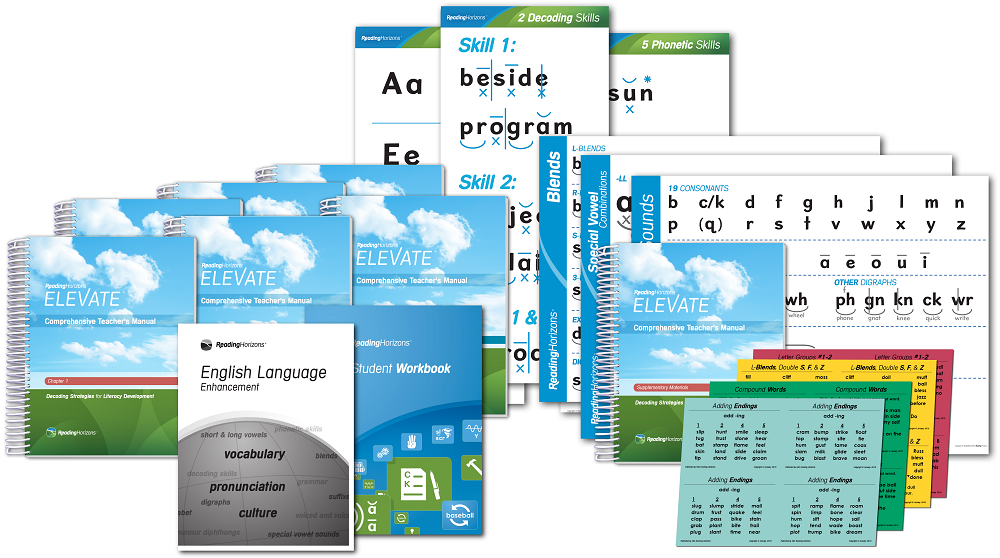
On July 14, 2014, Reading Horizons is releasing its updated Reading Horizons Elevate Teacher’s Kit, enhancing what was already a popular literacy program for ESL and intervention students with a colorful format and new features designed to engage teachers and students alike.

reading-horizons-reading-intervention-direct-instructionAt the heart of the Reading Horizons Elevate Teacher’s Kit is the Reading Horizons Elevate Comprehensive Teacher’s Manual—a multi-volume, non-consumable guide for teaching foundational reading strategies to students fourth grade through adult. Originally a black and white manual, it now features a two-color format with distinct, easy-to-read font styles that clearly contrast what teachers say (instruction) and what teachers do (actions, such as writing on the board). Graphics are used more extensively in the updated manual to make sure each step in this explicit, sequential program is taught correctly and completely.

The enhancements to the manual are not merely cosmetic; content has been added. Each skill lesson now includes numerous Enrichment Activities that reinforce the skills students are learning, and references to specific Transfer Cards so students practice not only spelling and decoding but also reading and pronunciation. At regular intervals throughout the new manual, teachers are encouraged to make use of Accelerate, a section on the Reading Horizons website that supports educators with how-to instruction videos and helpful resources.

Other components in the Reading Horizons Elevate Teacher’s Kit have also been updated or added. The Supplementary Materials Manual combines in one handy volume resources that were previously separated (the Teacher Supplement, the ELL Supplement, and the Games Supplement). The newly added Special Vowel Combinations Poster can be used for display during instruction and for student reference after instruction.

In addition to the components already mentioned, the Reading Horizons Elevate Teacher’s Kit features five more classroom posters and two consumable workbooks: the English Language Enhancement, which supports non-native speakers who are learning to read English, and the Student Workbook.

Given the success with the earlier version of the kit, Reading Horizons President, Tyson Smith, is understandably excited about the update. “The latest version of the Reading Horizons Elevate Teacher’s Kit represents the finest material we have ever published for teachers of adolescents and adults. The new format will make instruction even more intuitive and teacher friendly, and the Enrichment Activities will add a new level of engagement for students. I am proud of the efforts of our curriculum team in publishing this wonderful resource.”


About Reading Horizons:

Founded in 1984, Reading Horizons provides teacher training, teacher’s manuals, and interactive software that empower teachers to effectively teach beginning readers, struggling readers, and English Language Learners. By learning the core of the Reading Horizons framework, students have all of the skills they need to read the vast majority of words in the English language. The Reading Horizons program is currently offered in over 10,000 schools across the country. Follow Reading Horizons at www.readinghorizons.com.